Discover how a visual arts marketing agency builds cultural narratives, drives attendance, and boosts sales with strategic branding and digital campaigns.


A visual arts marketing agency should help you reach the right audience while staying true to the work you present. Compare agencies on three things: relevant arts experience, a clear plan for reaching visitors or buyers, and results they can measure, such as exhibition attendance, qualified inquiries, or artwork sales.
I’m Ben Visser, founder of Social Design House, a Charlotte creative studio with 16 years of experience in brand strategy, web design, and marketing. I’ll draw on that work to help you evaluate a visual arts marketing agency and choose a partner that fits your goals.
Discover more about visual arts marketing agency:
Marketing in the cultural sector is unique. You are connecting people to ideas, emotion, craftsmanship, and historic dialogue. A specialized marketing team serves as an extension of your staff to build an integrated system that supports your mission, your artists, and your bottom line.
We think of this work as building a foundation first, then a springboard. The foundation is clarity about who you are and who you serve. The springboard is the campaign work that launches exhibitions, drives ticket sales, and keeps donors engaged year after year.
Clear positioning gives your organization focus. When institutions treat their visual identity like an afterthought, audience connection drops. We help cultural teams articulate their narrative architecture and design every touchpoint with intention.
Comprehensive cultural institution branding establishes an emotional foundation for everything you do. From distinctive art gallery logo design to detailed audience profiling, your brand signals what visitors and patrons can expect the moment they walk through the door. A cohesive visual language shapes typography, color palettes, print collateral, gallery labels, and environmental wayfinding so every physical and digital touchpoint reinforces institutional credibility.
Great art speaks, but it needs an audience ready to listen. Compelling copywriting and deliberate exhibition messaging provide the context that invites people into the conversation.
We capture the studio process, distill curatorial essays into approachable narratives, and craft editorial assets that give depth to every show. This approach builds excitement while honoring the artist's original vision. By translating complex conceptual frameworks into accessible visual and written stories, marketing teams help first-time gallery visitors feel welcome while maintaining the intellectual rigor that seasoned collectors demand.
Good exhibition content also travels well. A strong press release, a thoughtful artist interview, and a tight set of social captions can all come from the same research, which saves your staff time and keeps every channel speaking with one voice.
Your digital home is your most active exhibition space. If your website is clunky or difficult to navigate, ticket sales and artwork inquiries stall out immediately.

A thoughtful art museum website redesign turns a basic digital brochure into an active platform for discovery. By focusing on conversion optimization, frictionless ticketing paths, and clear visual pacing, we ensure your online presence works as hard as your physical galleries. Fast page load times, responsive mobile viewing for high-resolution artwork, and streamlined inquiry forms turn passive digital browsing into physical gallery attendance and confirmed art sales.
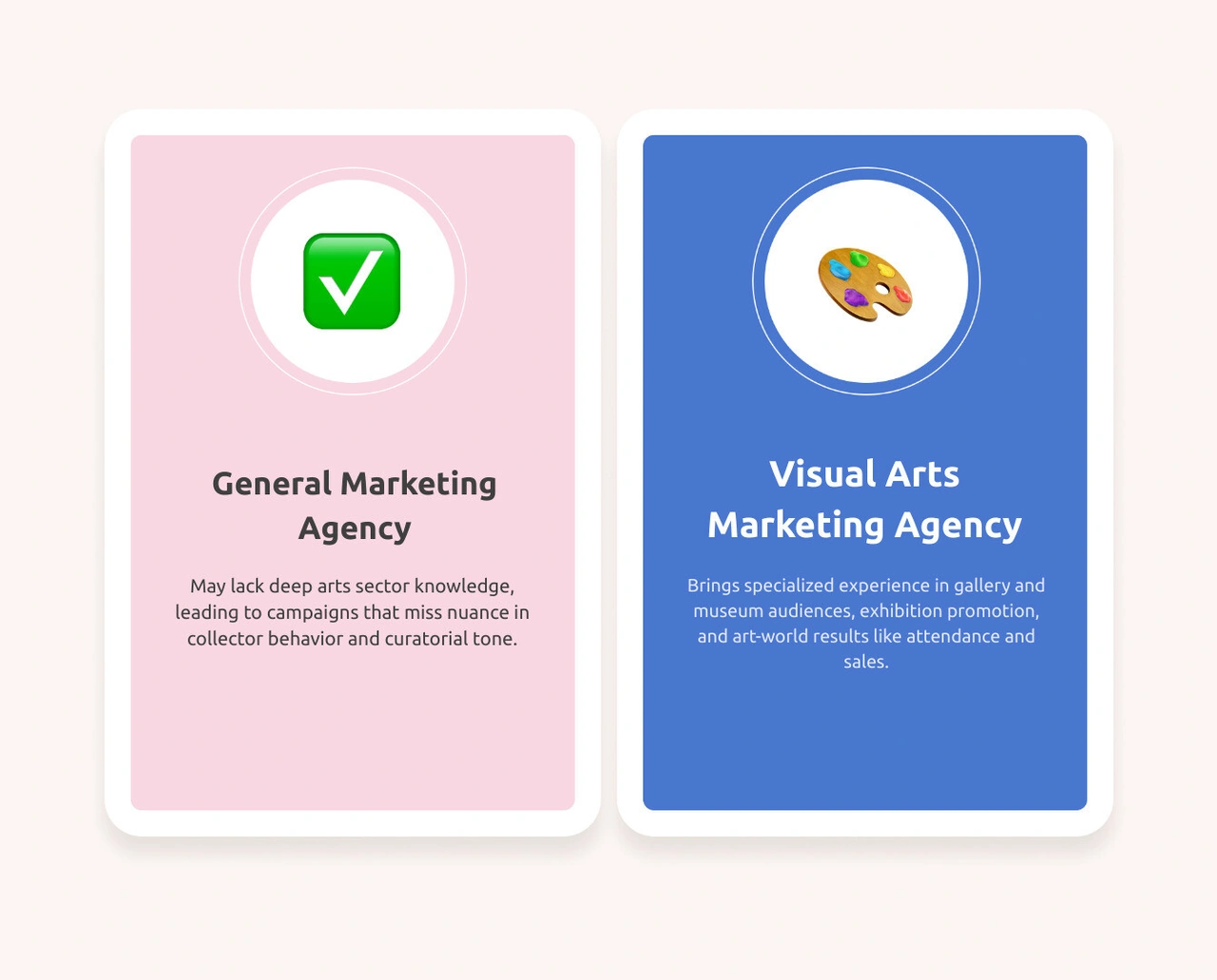
Generalist agencies often struggle with the subtle codes of the art world. Throwing standard retail promotions against the wall like spaghetti rarely attracts serious collectors or museum patrons.
| Feature | Specialized Arts Agency | General Marketing Agency |
|---|---|---|
| Collector Insights | Understands art advisory networks and acquisition cycles | Treats art like fast-moving consumer goods |
| Curatorial Voice | Aligns messaging with institutional rigor and artistic vision | Uses generic hype and transactional sales pitches |
| Institutional Strategy | Balances ticket sales, patron memberships, and donor relations | Focuses strictly on short-term direct clicks |
| Creative Craft | Prioritizes typography, editorial pacing, and aesthetic nuance | Relies on stock layouts and cookie-cutter templates |
When you are reviewing potential partners, look for teams that act as true collaborators rather than distant vendors. You need a group that respects the work and brings deep creative discipline to the table.
Working with an experienced branding agency for arts organizations ensures your portfolio curation, media kit, and digital catalog match the quality of the work hanging on the wall. Cultural leaders often consult industry standards from organizations like the American Alliance of Museums to benchmark their public outreach and educational programming against national best practices. A dedicated creative team builds marketing collateral that meets these high institutional standards while driving tangible visitor engagement.
Sustained museum attendance requires a clear path from community awareness to entry:
Social media gives your audience a window into the artistic process. Instead of treating these channels as billboard space, smart institutions treat them as digital extensions of their physical galleries.
Short-form video is a powerful tool for visual discovery. Showing an artist mixing pigments, installing a massive sculpture, or walking through their sketchbooks demystifies the finished piece and builds personal connection.
LinkedIn is a strong channel for museum leadership, gallery directors, and public art coordinators. It is the natural home for announcing civic commissions, discussing institutional governance, and building relationships with corporate art advisors.
Measuring cultural impact goes deeper than counting heads at the front desk. A healthy marketing ecosystem tracks engagement across the entire patron lifecycle.

None of these numbers mean much on their own. The real value comes from looking at them together over a full season, so you can see which stories and channels actually move people from curiosity to commitment. A gallery that pairs a strong opening night with a clear follow-up email sequence, for example, will often see membership renewals climb months later, long after the exhibition has closed. That kind of patient, connected measurement is what separates a marketing plan from a marketing habit.
The key is clarity and craft. We let the artist's ideas lead the message rather than forcing aggressive sales tactics onto the work. By presenting the conceptual foundation clearly, marketing supports the art without compromising its substance.
Success is measured across multiple touchpoints. Key indicators include advance ticket sales, exhibition foot traffic, online artwork inquiries, email subscriber growth, and sustained donor participation.
Budgets vary based on exhibition scale and institutional goals. Many organizations find that partnering with a fractional creative team provides access to senior brand strategy, web development, and campaign execution without the overhead of hiring an entire internal department.
Social Design House is a Charlotte-based creative studio with 16 years of experience operating as a 10-person fractional creative team and extension of client teams. We work side-by-side with directors, curators, and founders to clarify their message, design exceptional brand systems, and launch websites that convert interest into sustained attendance.
Our values are Collaborative, Kind, Creative, Curious, Crafted, and Confident. We use our AI Brand Framework to build structured marketing strategies that keep cultural institutions visible, relevant, and organized. To see how we support galleries, foundations, and creative institutions, explore our work in the arts & museums industry and find your sweet spot.