Compare the top 10 commercial real estate website templates for 2026, from coworking to industrial, with in-depth reviews and essential features.

.svg)


The top commercial real estate website templates include Coworking X for flexible offices, Commerce Realty Lite for high-speed Astro builds, Floorplan for urban office brokerages, Vault for industrial logistics, and Houzez for WordPress portals. Choosing the right template depends on your asset class, underwriting data requirements, and investor workflows.
Building an effective online presence for commercial properties requires a dedicated approach. Commercial buyers, institutional investors, and corporate tenants evaluate spaces through financial metrics, zoning allowances, structural capabilities, and logistics data. To help you select the ideal digital foundation for your portfolio, we have analyzed the best web frameworks available in 2026.
While residential websites focus on neighborhood charm, school districts, and lifestyle imagery, dedicated commercial real estate websites prioritize underwriting transparency and operational specs. When considering what makes a great residential real estate website, the focus is often on emotional connection and broad consumer search tools.
In contrast, commercial real estate templates must handle complex industrial and office data points:
Evaluating real estate website design templates means balancing performance, ease of customization, and listing functionality. Here is how the top options compare across platforms and asset classes.
| Template Name | Platform | Best Asset Class / Use Case | Key Features |
|---|---|---|---|
| Coworking X | Webflow | Flexible Offices & Marketplaces | CMS filtering, booking flows, Figma assets included |
| Commerce Realty Lite | Astro 7 + Tailwind v4 | High-Performance Portals & Land | Static page speed, JSON-driven listings, pure CSS |
| Floorplan | Rocket HTML / Tailwind | Urban Office Brokerages | Dark immersive styling, 5-step interactive assessment |
| Vault | Custom React / Next.js | Logistics & Industrial Warehouses | Count-up metrics, spec overlays, aerial video bays |
| Meridian | Lokuma / Webflow | Full-Service Commercial Agencies | AI metadata generation, Mapbox maps, market data charts |
| Executive Listing | Rocket HTML / Webflow | Capital Markets & Investment Sales | Upfront cap rates, Offering Memorandum gated workflows |
| Houzez | WordPress + Elementor | Multi-Asset Portals & Marketplaces | 49 demo designs, IDX/MLS integrations, visual building |
| Canva CRE Pack | Canva Web | Boutique Showcases & Quick Pitches | Fast drag-and-drop editing, direct PDF export workflows |
| Figma CRE UI Kit | Figma | Custom Enterprise Prototyping | Semantic token library, responsive component systems |
| Made in Webflow CRE | Webflow | High-End Architecture & Redevelopments | Advanced scroll interactions, 3D floor plan viewers |
The Coworking X Webflow Template is built specifically for shared office operators, enterprise incubator hubs, and flexible workspace marketplaces. It features dedicated CMS collections for individual office suites, meeting rooms, and event spaces.
Its visual architecture includes three distinct header configurations, customizable notification banners, and responsive layouts that look crisp on screens ranging from mobile phones to high-resolution desktop monitors. Buyers also receive downloadable Figma source files, making it simple to map out custom brand assets before editing live CMS collections.
Developers seeking raw speed and clean code will appreciate the Astro Commercial Real Estate Lite Theme. Built with Astro 7 and Tailwind CSS v4, this static theme scores a 96 out of 100 on Lighthouse Performance tests straight out of the box, with the ability to reach a perfect 100 score when using locally hosted property images.
The template completely eliminates heavyweight JavaScript frameworks, using clean semantic HTML and CSS tokens. It includes dedicated data files for office, industrial, and retail listings, complete with built-in Open Graph metadata, per-page canonical tags, and automatic sitemap generation.
For tenant-rep brokers marketing downtown subleases and modern corporate towers, the Cinematic CRE Landing Page Template provides a visually striking experience. It uses a dark aesthetic with deep graphite tones and pale blue interactive accents.
Instead of displaying an unorganized list of properties, Floorplan guides visitors through a location search with neighborhood tags, followed by an interactive gallery walk. A built-in five-step space assessment collects team size, desired lease terms, and budget parameters, allowing brokers to qualify leads before hopping on a discovery call.
The Premier Warehouse Landing Page Template is tailored for logistics parks, cross-dock distribution centers, and manufacturing assets. It opens with an animated count-up hero highlighting leased square footage, total closed transaction volume, and active market coverage.
The page utilizes full-width aerial photography modules paired with clear spec overlays that display essential details like clear heights, column spacing, and power capacity. Single-objective landing pages of this style can increase conversion rates by up to 80 percent compared to generic multi-page websites by keeping institutional investors focused on leasing metrics.
Designed for full-service commercial brokerages, the Meridian Urban Real Estate Template delivers high-impact architectural layouts alongside market intelligence tools.
Key structural elements include:
The Executive Commercial Listing Landing Page Template solves the common problem of lead drop-off by presenting financial metrics upfront. Instead of hiding critical underwriting numbers behind complex forms, this template places cap rates, gross square footage, and current vacancy percentages directly on property cards.
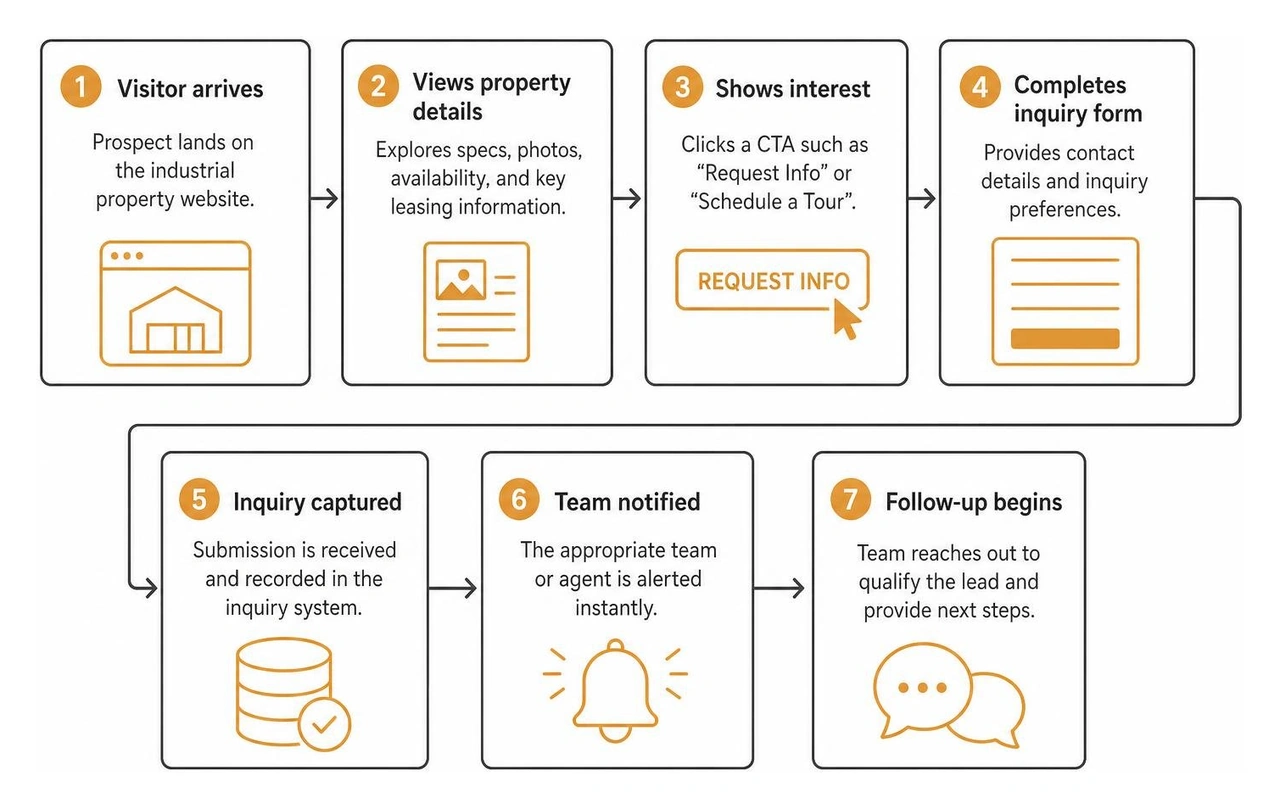
The user journey features two clear paths: a concise four-field request form for the confidential Offering Memorandum (OM) and an integrated calendar module for scheduling physical property tours.
Houzez remains a reliable WordPress framework for commercial firms requiring deep database customization. The theme package includes 49 professionally designed real estate website demos, supporting agency directories, multi-vendor commercial marketplaces, and single-asset showcases.
Because it integrates natively with Elementor, marketing teams can adjust headers, footers, and listing grids without writing code. It also supports property synchronization feeds from regional listing networks and includes multi-language translation tools for firms working with international capital partners.
For emerging brokerages or single-property marketing efforts on a tight timeline, Canva provides a simple web publishing option. Their commercial real estate template set allows teams to arrange listing specs, floor plans, and team bios using an intuitive drag-and-drop editor.
While Canva sites lack advanced relational databases, they allow you to launch a live, mobile-responsive web showcase or export the entire layout as a high-resolution PDF pitch deck in just a few minutes.
Firms planning a completely custom digital platform often start with a dedicated Figma commercial real estate design kit. Utilizing ready-to-edit Figma wireframes can reduce initial design timelines by an average of 40 percent.
These UI kits include responsive layout components, interactive map interfaces, property comparison charts, and color systems. This allows teams to test usability and align stakeholders before beginning web development.
The community-driven Commercial Real Estate Designs in Webflow collection features advanced, cloneable project foundations built by experienced designers. These builds highlight modern design patterns such as split-screen listing views, smooth scroll interactions, and interactive building floor plans.
These projects offer a strong starting point for commercial real estate firms that want engaging, interactive websites connected directly to the Webflow visual content management system.
Understanding what are the most important features for a commercial real estate website helps you choose a template that supports actual deal velocity.
Key functionality to look for includes:
Firms evaluating templates should check if a prospective website can integrate with property management software and CRMs to ensure automated data syncing across their pipeline.
Modern visual site builders make brand alignment straightforward for marketing managers. When customizing a template, focus on established principles of digital user experience strategy to keep pages clear and easy to navigate.
Begin by establishing global typography rules, using clean sans-serif typefaces for technical property specs and authoritative serif headings for brand positioning. Maintain consistent accent colors on conversion buttons, map pins, and spec downloads to guide the visitor through the page.
While free templates on platforms like Canva work well for basic asset sheets, paid themes and custom platforms offer better long-term scalability. Understanding what is the typical cost of developing a commercial real estate website helps teams balance initial template purchases against long-term custom engineering.
Paid templates usually provide cleaner code, regular security patches, built-in search engine optimization controls, and flexible CMS collections, reducing technical issues as your listing portfolio expands.
A visually appealing template must be backed by technical speed and search engine visibility. Implementing modern SEO, AEO & GEO practices ensures your assets surface when corporate tenants and investment funds search for specific regional spaces.
Understanding how a commercial property website can attract more tenants and investors involves optimizing three core technical areas:
Yes. Many WordPress and Webflow platforms connect to commercial listing exchanges, regional MLS feeds, and enterprise CRMs. For firms wondering can you integrate MLS or listing platforms into our website, modern themes accomplish this using custom webhooks, REST APIs, or specialized plugins that sync property updates automatically.
Commercial landing page templates use structured multi-step forms instead of simple email fields. These forms capture target move-in dates, square footage requirements, required power capacities, and budget ranges, ensuring your brokerage team spends their time on qualified prospects.
When reviewing how long it takes to design and launch a commercial property website, deploying a pre-built template can take anywhere from a few days to three weeks. The overall timeline depends on asset data readiness, architectural photography gathering, and custom domain setup.
Selecting the right commercial real estate template provides your team with a solid, professional foundation. Whether you need a high-converting single-property landing page, an industrial logistics hub, or a multi-asset corporate portal, starting with clear specifications and fast code will make a measurable difference in your lead generation.
At Social Design House, we are a Charlotte-based 10-person creative studio with 16 years of experience operating as a fractional creative team. Our core services include brand identity and strategy, web design and development across Webflow and WordPress, content creation, copywriting, performance marketing, and our AI Brand Framework.
We help commercial real estate leaders simplify complex ideas and create digital experiences that truly resonate. To learn how we can help your properties stand out in any market, explore our specialized approach to Commercial Real Estate Website Marketing Charlotte and let our team help you find your sweet spot. Excited to continue building high-performing web platforms together!