Boost revenue with website conversion testing services that deliver real results through data-driven experiments, UX audits, and full-funnel optimization.


Website conversion testing services help you find where visitors get stuck, test possible fixes, and measure whether those changes lead to more sales or qualified leads. Look for a provider that can audit user behavior, run A/B tests, implement changes safely, and connect results to your analytics. Ask how they measure success before you hire them.
A good test starts with a clear problem, such as a form people abandon or a landing page with too many choices. The result gives your team evidence for what to improve next.
I’m Ben Visser, founder of Social Design House. For more than 15 years, I’ve helped growing brands build websites that drive traffic and conversions, and I’ll walk you through how to evaluate website conversion testing services.
Discover more about website conversion testing services:
Getting steady traffic to your website is exciting, but traffic without action leaves revenue on the table. The average website conversion rate in 2026 sits right around 3.2% across industries. That means roughly 97 out of every 100 visitors leave without buying, filling out a form, or reaching out.
Modern website conversion testing services exist to fix that leaky bucket. Rather than guessing why people leave or throwing random design tweaks at the wall like spaghetti, specialized conversion testing pairs qualitative user research with strict quantitative experimentation. It builds a solid foundation for continuous revenue growth by uncovering visitor motivations and systematically removing friction. Professional digital user experience strategy connects these qualitative observations directly to revenue goals, ensuring your site serves clear business objectives.
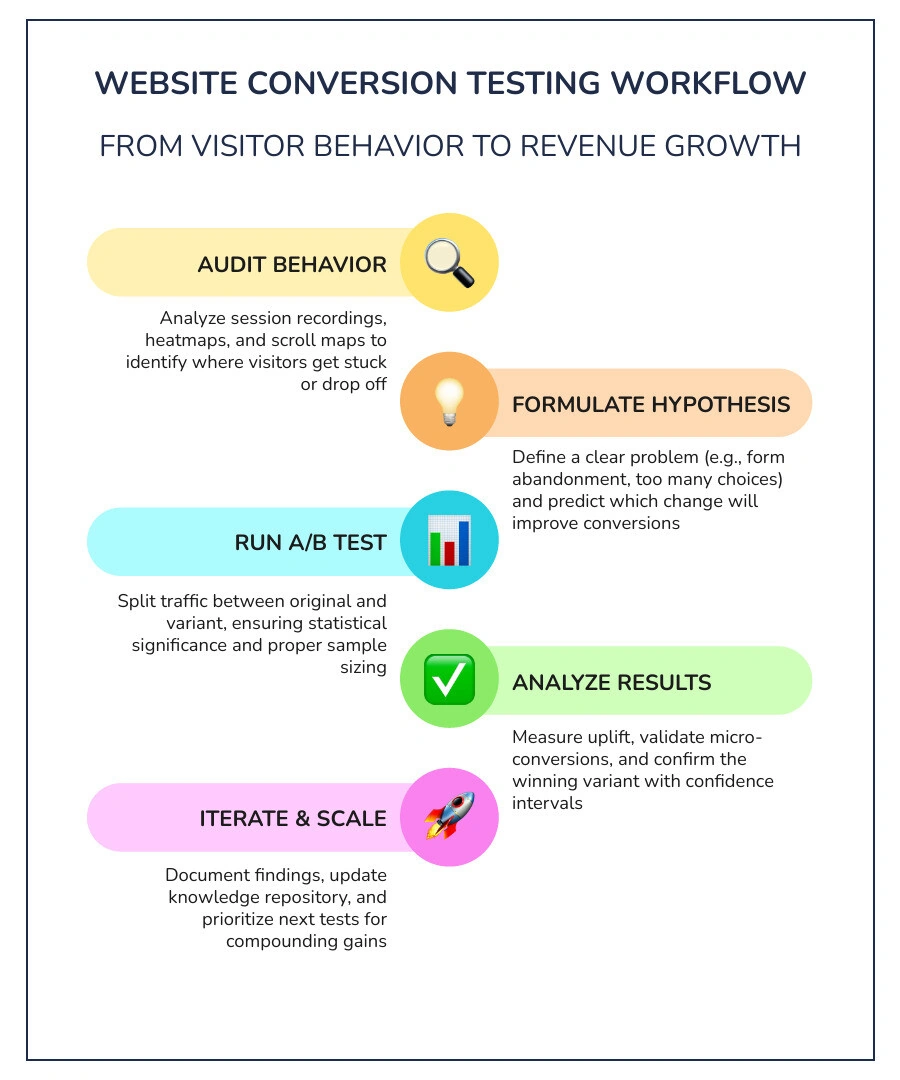
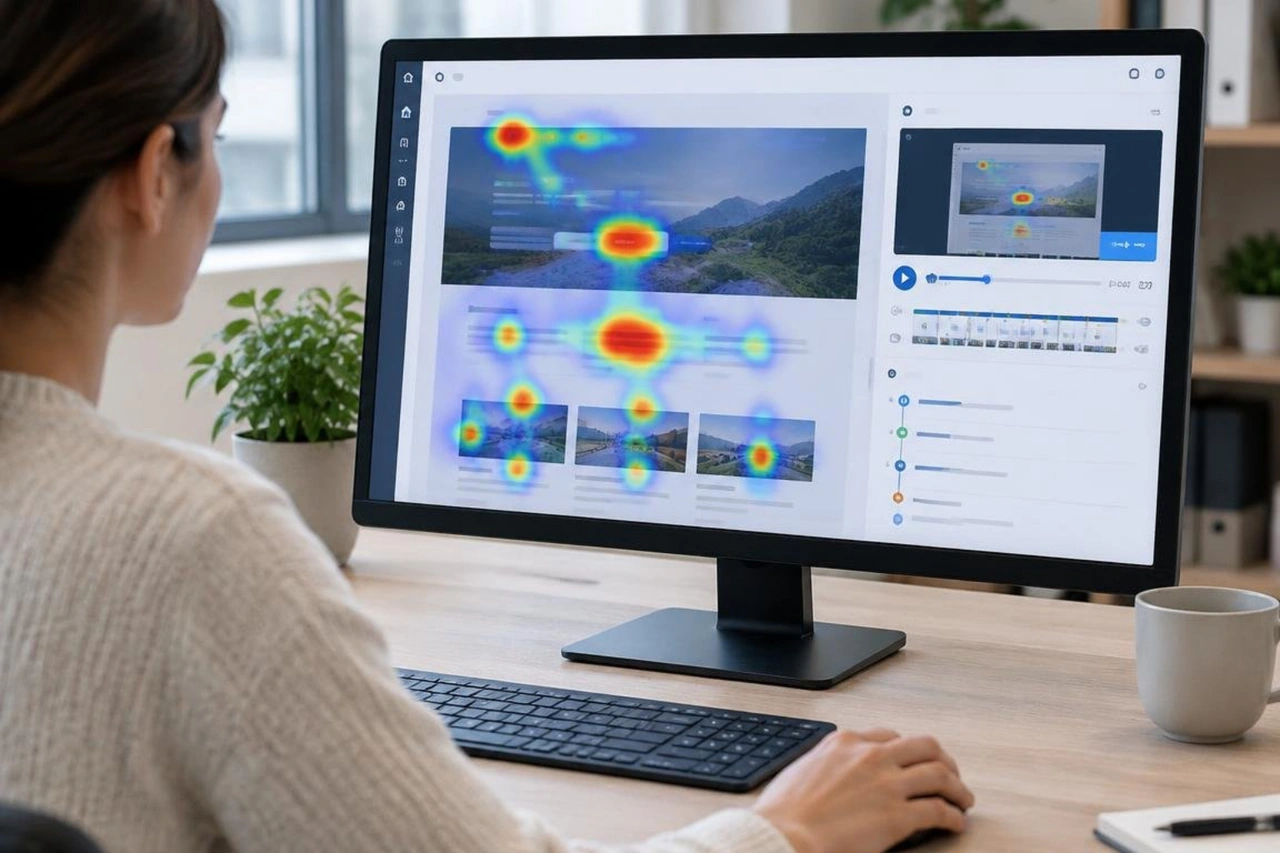
Every strong testing program begins by diagnosing real human behavior. An experienced testing partner looks past surface metrics to analyze how users navigate your pages.
Mapping user intent against actual on-page actions gives teams clear clarity on what needs fixing. When you pair behavioral mapping with strategic website conversion design, you turn confusing layouts into focused journeys that make buying simple and natural.
Once user bottlenecks are clear, conversion teams design controlled experiments to test improvements.
Standard split testing divides live traffic between an original page (the control) and an updated version (the challenger). By isolating a single variable, such as a revised headline, a new checkout layout, or a streamlined hero section, you know with statistical confidence which element produced the result.
For high-traffic platforms, multi-armed bandit algorithms can dynamically allocate more traffic to winning variations in real time, capturing revenue gains while still exploring alternative options. Multivariate tests explore how combinations of copy, imagery, and layout interact together. Establishing accurate baseline metrics before launching tests helps ensure your uplifts are genuine and repeatable.
Great test ideas fall flat if poor technical implementation slows down your site or breaks tracking. A professional testing team acts as an extension of your development crew, building clean code that integrates seamlessly with your tech stack.
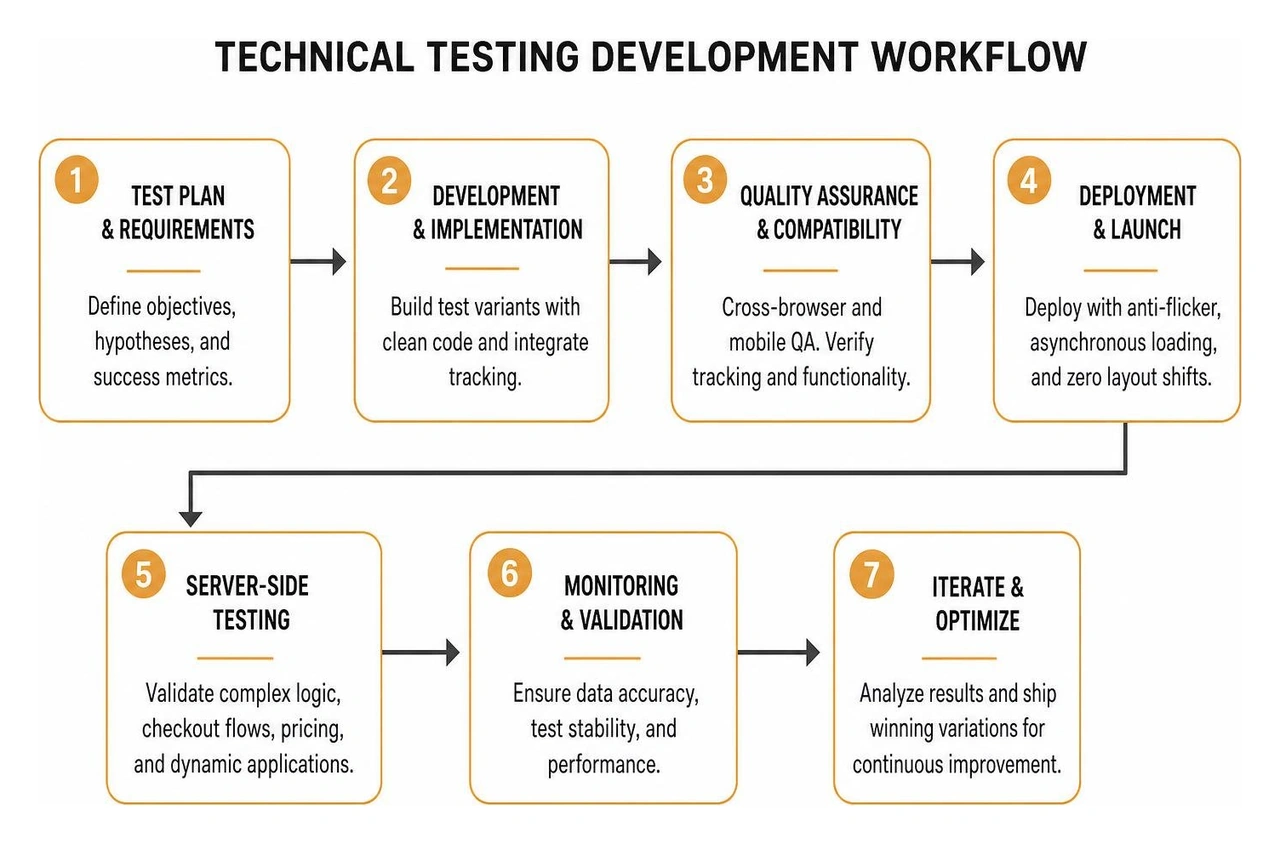
Reliable technical delivery includes:
When technical execution matches creative strategy, supported by custom website design and development, your experiments run reliably without pulling your internal engineers away from product roadmaps.
Top-performing conversion teams execute a structured, repeatable framework. Industry data shows that teams executing 15 to 30 tests per month often see cumulative conversion rate gains of 20% to 40% per year.
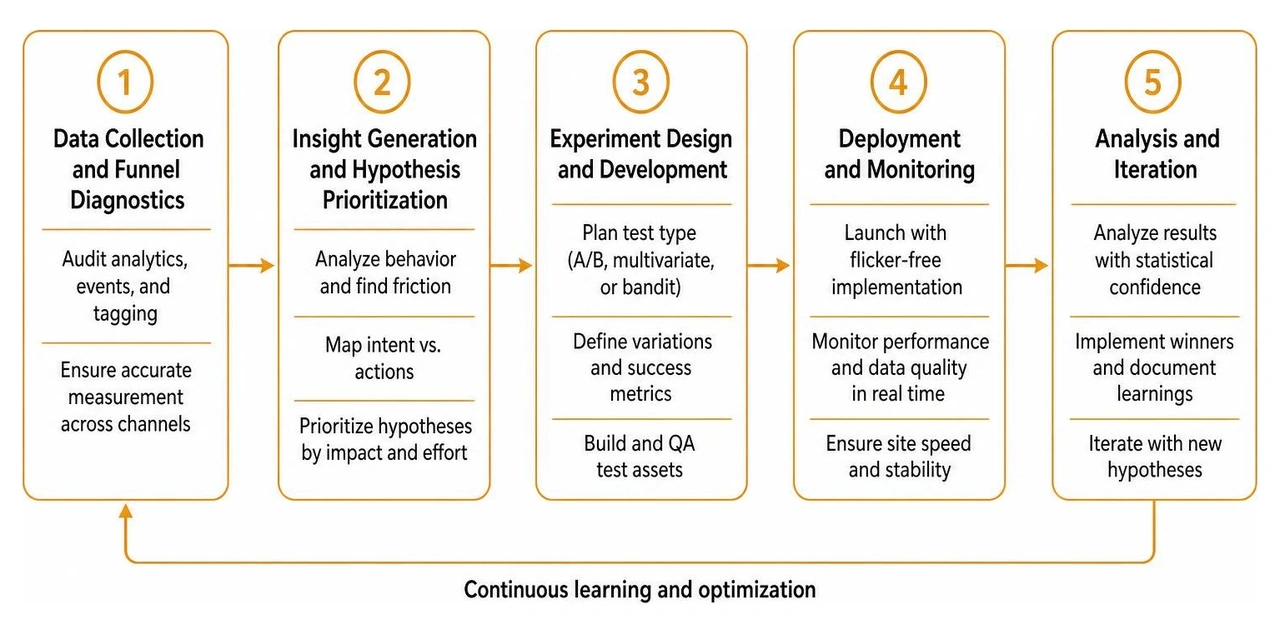
Here is the exact step-by-step methodology we use to guide experiments from raw data to revenue lift.
Rigorous testing requires dependable tracking. We start by auditing your Google Analytics 4 configuration, data layers, and tag governance to make sure conversion events record accurately across all traffic sources. If you want to see how data and usability work together, our guide on how analytics factor into UX breaks down how we turn event tracking into practical design decisions.
We look at conversion rates by device, traffic channel, and audience segment. Knowing that desktop converts at an average of 4.8% compared to mobile at 2.3% gives us concrete baseline targets for mobile friction audits.
A solid hypothesis follows a clear structure: "By making [change] on [page], we expect [specific outcome] because [data-backed insight]."
We prioritize test ideas using proven scoring models, such as the Potential, Importance, and Ease (PIE) framework. This keeps your testing calendar focused on high-traffic, high-friction areas that offer the fastest path to measurable revenue gains.
Designing a test variant emphasizes clarity and focus. We strip away distractions, establish clear visual hierarchy, and craft straightforward copy.
Research shows that landing pages with a single clear CTA convert 266% better than pages cluttered with competing options. We focus user attention on a single primary action, write clear value propositions, and align visual elements with your brand standards.
Once developed and tested across devices, experiments go live with controlled traffic splits. We monitor test health daily to verify data consistency and prevent sample ratio mismatches.
Tests run until they reach statistical significance (typically 95% confidence) and capture full business cycles, including weekday and weekend traffic patterns. This prevents false positives caused by sudden traffic spikes or external marketing campaigns.
When a test concludes, we dig into both primary conversions and secondary micro-conversions, like scroll depth and video completions. Winning tests deliver an average lift of 12% to 15%, which we then permanently hardcode into your site.
Even when a test produces no clear winner, the data teaches us something valuable about your audience's preferences. We log every finding into a centralized experiment repository, using those insights to shape the next round of tests. If your website not converting remains an ongoing challenge, this structured analysis quickly pinpoints whether the breakdown stems from messaging, layout, or technical friction.

High-value industries such as financial services, commercial real estate, and B2B SaaS face unique conversion challenges. Traffic in these spaces is expensive, and conversion funnels must handle detailed lead collection, compliance disclosures, and high buyer hesitation.
The global average shopping cart abandonment rate is 70.2%, climbing to nearly 78% on mobile devices, according to Baymard Institute's research. For lead generation, long forms with too many fields cause similar drop-offs.
Every additional second of page load time reduces conversion rates by an average of 7%. A page that loads in one to two seconds converts up to 2.5 times better than a page taking five seconds or longer.
Conversion testing services audit Core Web Vitals, compress media assets, and clean up bloated scripts. On mobile screens, placing primary CTA buttons within the natural thumb zone (the bottom 40% of the viewport) can boost click-through rates by 32%. Fast, responsive layouts keep visitors engaged and ready to act.
In regulated industries like mortgage lending and wealth management, trust is everything. Unclear legal disclosures can increase perceived risk and cause users to abandon their applications.
Placing prominent trust signals, such as security badges, industry accreditations, and clear privacy language, directly next to form inputs and submit buttons increases conversion rates by 11% to 34%. Stating estimated completion times and eligibility checklists upfront gives users the confidence they need to finish the process.
Building an effective conversion testing program requires choosing the right team structure. The comparison table below outlines the core models available for growing brands.
| Delivery Model | Primary Focus | Best Suited For | Key Advantages | Potential Limitations |
|---|---|---|---|---|
| Dedicated CRO Agency | Full-funnel strategy, user research, and testing roadmaps | Brands wanting complete optimization strategy and ongoing growth | Deep behavioral expertise, end-to-end execution, and continuous testing velocity | Requires cross-team communication with internal web developers |
| Technical Implementation Partner | Custom test development, QA, and flicker-free deployment | In-house teams or creative agencies needing dedicated coding support | Fast development cycles, clean code, and zero site flicker | Relies on your team to provide strategy, research, and creative briefs |
| In-House Experimentation Team | Day-to-day testing across internal product teams | Large enterprise organizations with high traffic and dedicated resources | Deep institutional knowledge and direct access to company systems | High recruitment costs and competing internal project priorities |
Some teams start with focused, standalone evaluations. Rapid heuristic reviews can spot quick UX fixes. For comprehensive, data-driven roadmaps that tie user behavior directly to paid campaigns, research-led teams combine heatmaps, recordings, and structured testing plans.
Investing in conversion rate optimization delivers an average return on investment of 223%. Instead of constantly increasing your paid advertising spend, testing maximizes the revenue generated from your existing audience.
Because only about 14% of A/B tests produce a statistically significant winner, continuous testing is essential. A 12% to 15% uplift on winning tests compounds over time, lowering your customer acquisition costs and creating a more profitable, sustainable marketing funnel.
When evaluating conversion testing partners, look for teams that combine technical discipline with strategic design thinking. Ask these practical questions during your evaluation:
A full site redesign overhauls your entire website at once based on subjective design trends, which makes it hard to know which changes helped or hurt conversions. Conversion testing uses an iterative, data-driven approach. By testing specific changes against your live baseline, you isolate variables, protect existing revenue, and make improvements backed by real user data.
Most tests need to run between two and six weeks. The exact duration depends on your traffic volume, the number of variations, and how long it takes to reach 95% statistical confidence. Running tests for at least two full business cycles accounts for natural fluctuations between weekday and weekend user behavior.
Industry benchmarks show an average ROI of 223% from structured conversion optimization investments. By systematically lifting conversion rates by 10% to 20% across key funnels, businesses see substantial revenue gains, lower customer acquisition costs, and stronger returns from their existing marketing channels.
Building a high-converting website is an ongoing process of learning, testing, and refining. When you replace guesswork with clear data, user research, and disciplined experimentation, you build a dependable engine for customer acquisition and pipeline growth.
At Social Design House, we operate as a fractional creative team and extension of your brand. We bring 16 years of hands-on experience in web design, development, and conversion strategy to help you find your sweet spot and build digital experiences that drive real, measurable results.