Learn how web design for mortgage lenders boosts lead conversion with interactive tools, mobile-first UX, and SEO strategies from a fractional creative team.

.svg)


Web design for mortgage lenders should give borrowers a fast, credible way to view rates, understand loan options, and request a quote before they are ready for a formal application.
A strong mortgage website should include:
Nearly half of home buyers begin their search online, and visitors form a first impression in about 50 milliseconds. Your website must validate a referral, answer early questions, and make the next step feel simple, not easy.
I am Ben Visser, founder of Social Design House, a Charlotte-based 10-person creative studio with 16 years of experience as a fractional creative team. Our work in Web design for mortgage lenders draws on brand strategy, Webflow and WordPress development, content, copywriting, performance marketing, and our AI Brand Framework, which we built to help growth-focused brands find their sweet spot.
Creating an engaging online experience for prospective borrowers requires combining clear visual communication with financial software tools. Borrowers want immediate answers regarding interest rates, estimated monthly payments, and loan program eligibility. When mortgage site design focuses on clarity, prospective clients quickly find answers and feel confident starting a conversation.
The hero section acts as the digital front door of your lending business. When prospective borrowers arrive on your homepage, they form an opinion almost instantly. A cluttered layout or vague messaging creates friction, causing visitors to return to search engine results.
Effective hero sections keep copy direct, clear, and easy to skim. Instead of demanding that a site visitor complete a full 20-minute application right away, high-converting hero sections offer dual choices:
Header navigation should stay streamlined and organized. Clean dropdown menus with subtle hover states allow users to explore specific products, including Conventional, FHA, VA, USDA, and Non-QM loans, without feeling overwhelmed. Including direct contact details, NMLS numbers, and quick quote buttons in the top header makes reaching out effortless.
Providing real-time financial tools turns passive readers into active users. Home buyers often browse multiple websites during their initial research phase to compare mortgage terms. Presenting live rate tables and interactive payment calculators directly on key landing pages delivers immediate utility.
Lenders can connect product pricing engines directly to their web pages using secure APIs. This setup enables real-time rate updates, displaying customized scenarios based on loan terms, purchase prices, and down payment amounts.
Useful interactive features for mortgage sites include:
Adding a live rate comparison table can triple or quadruple conversion rates for qualified leads. Delivering transparent information up front builds immediate goodwill and gives prospects a clear reason to bookmark your site.
Securing a mortgage is one of the largest financial decisions a home buyer ever makes. Trust is an absolute prerequisite for conversion. If your site looks dated, confusing, or hidden behind vague forms, visitors will go elsewhere.
Integrating verified client testimonials, Google review ratings, award badges, and team credentials right alongside your main calls to action demonstrates reliability. Showing real loan officers with detailed bios humanizes the experience, letting clients know exactly who will guide them through the process. Real-world sites like On Point Home Loans, Inc. show how presenting local market expertise alongside modern design builds borrower confidence.
Pairing trust signals with soft, top-of-funnel calls to action yields higher conversion rates than aggressive sales pitches. CTAs like "Calculate Your Payment," "See Today's Rates," or "Explore Loan Options" invite participation without forcing borrowers to share sensitive personal information before they are ready.

Borrowers frequently switch between mobile phones, tablets, and desktop computers during their mortgage search. A buyer might view an open house on a weekend, run quick payment scenarios on a smartphone, and later review detailed rate options on a desktop screen. Your website must perform seamlessly across every screen size.
Most online searches begin on mobile devices. When prospective buyers look up a loan officer after receiving a word-of-mouth referral, they land on mobile pages first. If text is too small, buttons are difficult to tap, or calculators break on mobile screens, you risk losing that client immediately.
Designing mobile pages for this Point of Research means optimizing touch targets, eliminating heavy scripts that slow down page loads, and using clean vertical layouts. Clean development standards built on modern platforms, like our custom Webflow Website Development processes, help ensure lightning-fast performance, smooth animations, and flawless mobile responsiveness across all devices.
Converting casual visitors into qualified inquiries requires a clear, step-by-step path. Replacing long, daunting contact forms with dynamic multi-step quiz funnels keeps visitors engaged while gathering essential qualification details.
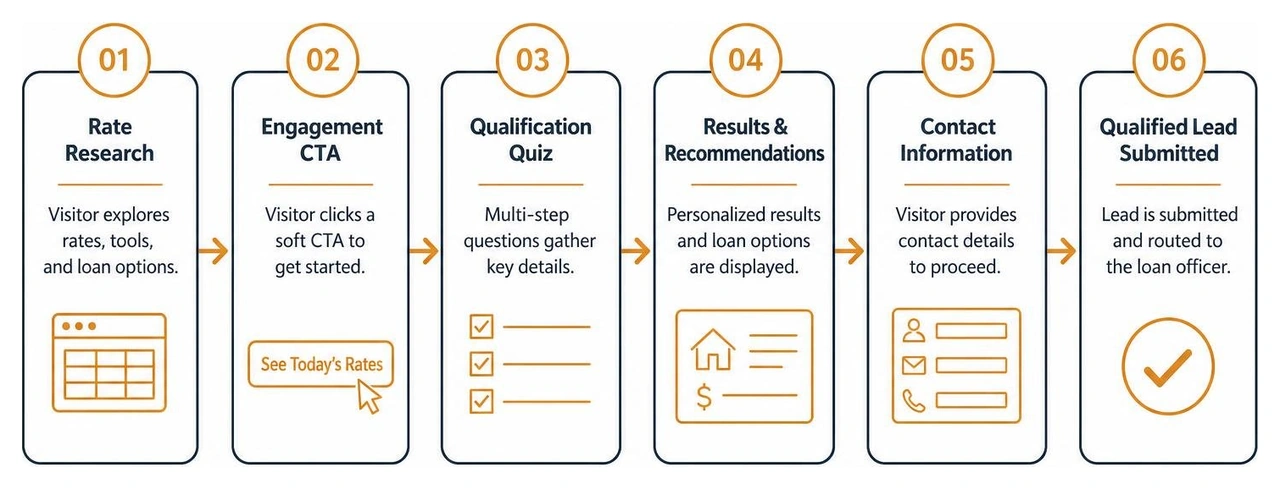
Multi-step questionnaires ask one simple question at a time:
Using visual progress bars and partial completion rings gives users a clear sense of momentum. This progressive approach feels conversational and helps your team capture well-qualified leads ready for follow-up.
Choosing between a pre-made website template and a custom-built solution depends on your growth stage, brand goals, and system needs. Both choices offer distinct advantages depending on your operational focus.
| Feature / Capability | Templated Mortgage Websites | Custom Agency Web Development |
|---|---|---|
| Launch Timeline | Rapid deployment (often within days) | Strategic discovery and design phase |
| Design Flexibility | Pre-set layouts and standard color fields | Custom brand strategy, visuals, and layouts |
| Integrations | Basic CRM and standard contact forms | Custom pricing engine APIs, POS, and CRM connections |
| Brand Differentiation | Shared visual structure with other lenders | Exclusive, tailormade brand identity |
| Content Ownership | Platform-dependent platform hosting | Full ownership of source design and web assets |
| SEO & Local Scaling | Standard templates and meta tags | Deep technical SEO, schema, and custom content hubs |
Template solutions offer quick turnarounds for independent loan officers who need a basic web presence right away. They provide standard rate charts, basic calculators, and simple contact forms.
However, growing mortgage companies and regional lenders often outgrow generic templates. Custom web development allows you to connect specialized Point of Sale (POS) tools, Loan Origination Systems (LOS), and automated marketing CRMs directly into your site structure. Custom design also lets you introduce unique brand identity elements, bespoke vector graphics, and tailored landing pages that set your firm apart from competitors.
Your website is an appreciating marketing asset that you own and control. Shifting focus away from third-party ad networks and investing in owned web infrastructure builds long-term organic authority and lowers lead acquisition costs over time.
A custom site built on flexible systems gives your team total ownership over messaging and content expansion. You can quickly add new loan officer profiles, publish market updates, launching specialized landing pages, and adjust conversion pathways without technical hurdles.
Modern search engine optimization extends beyond traditional keyword searches on Google. Today, prospective borrowers also use AI answer engines and chat tools to research mortgage requirements, compare loan types, and locate top-rated originators nearby.
To help search engines and AI systems index and recommend your services, your website content must be structured logically. Organizing information into clear semantic content hubs establishes domain authority around specific loan programs and regional lending markets.
Key structural elements include:
Structuring site content clearly helps search algorithms accurately extract facts about your loan products and present your business as a trusted answer for local borrowers.
Most borrowers are introduced to a loan officer through a real estate agent, friend, or family member. The moment that referral occurs, the prospect immediately searches the loan officer's name online to verify credentials and reviews.
Your website serves as crucial validation during this phase. Detailed loan officer landing pages featuring personal bio videos, direct contact options, client reviews, and local market expertise reassure buyers they are working with a seasoned professional. Our project review showcasing Website Design for Mortgage Professional: Jenny Farrell demonstrates how personal storytelling and professional design build trust long before the first phone call.
A mortgage website should project warmth, clarity, and deep financial competence. Outdated site layouts, harsh color schemes, or generic stock photos reduce trust and make loan products feel transactional.
Combining clear visual hierarchy, thoughtful typography, and accessible color palettes creates an inviting digital space. Aligning your website design with a Modern Brand Identity reflects the care, precision, and patient service you deliver during the loan process, giving your team immense confidence when sharing your business online.
Live rate comparison tables connected to pricing engine APIs consistently generate the highest engagement. Pair these with interactive payment calculators that estimate principal, interest, taxes, and insurance. Multi-step lead intake funnels with visual progress bars also convert higher than standard contact forms because they make sharing information feel effortless.
Most website visitors are early in their home-buying journey and seeking basic market information. Pushing a full, formal loan application immediately creates unnecessary friction for research-phase visitors. Offering value-driven options like "View Today's Rates" or "Get a Custom Quote" invites engagement, captures lead details early, and builds trust before moving into the formal application stage.
Turnkey templated websites using standard layouts can launch in as little as five business days once logos, bios, and compliance information are provided. Custom agency website builds that include custom brand strategy, tailored UI/UX design, custom API integrations, and specialized content creation typically take six to twelve weeks to complete.
A well-designed mortgage website serves as your absolute best 24/7 sales representative. By delivering real-time pricing tools, intuitive mobile experiences, and clear trust signals, your firm can validate referrals and consistently convert researching visitors into qualified home loan clients.
For 16 years, our team at Social Design House has operated as a Charlotte-based 10-person creative studio functioning as a fractional creative team for growth-minded businesses. Our core services include brand identity and strategy, web design and development across Webflow and WordPress, content creation and copywriting, performance marketing, and our AI Brand Framework, which we built to help lenders find their sweet spot.
If you are ready to strengthen your digital presence, explore our Website Design & Development Charlotte capabilities or connect directly with our team at Charlotte Branding and Website Design Agency. Excited to continue building high-performing web experiences that help your mortgage business succeed!