We're past the "will they use it" phase. Your team is already in ChatGPT. They're in Claude. They're in Gemini. Marketing is using it for social captions, sales is drafting outreach emails, leadership is tightening up internal comms. It's happening, and honestly, that's a good thing. The problem is there's no alignment.
.svg)


Every person on your team is running their own version of your brand through AI right now. Different prompts, different context, different outputs. One person's ChatGPT thinks you're buttoned-up corporate. Another's thinks you're a scrappy startup. Someone in sales has a custom GPT that sounds nothing like what marketing is putting out. Too many cooks in the kitchen, and nobody's working from the same recipe.
For years, the brand style guide has been a PDF. You know the one. Logo usage, color codes, maybe some mission-vision-values language tucked in the back. It gets emailed around during onboarding and never opened again.
That PDF was built for a human audience. Designers reference it for hex codes. Marketing might pull a tagline from it. But when your team sits down with an AI tool, that PDF doesn't go with them. It can't. ChatGPT doesn't flip through your brand guide before it writes that email for you.
So the output is generic. Or worse, it's confidently off-brand. And if you've ever gotten back a draft from AI that sounds like it could belong to literally any company, you know the feeling. That's a context problem.
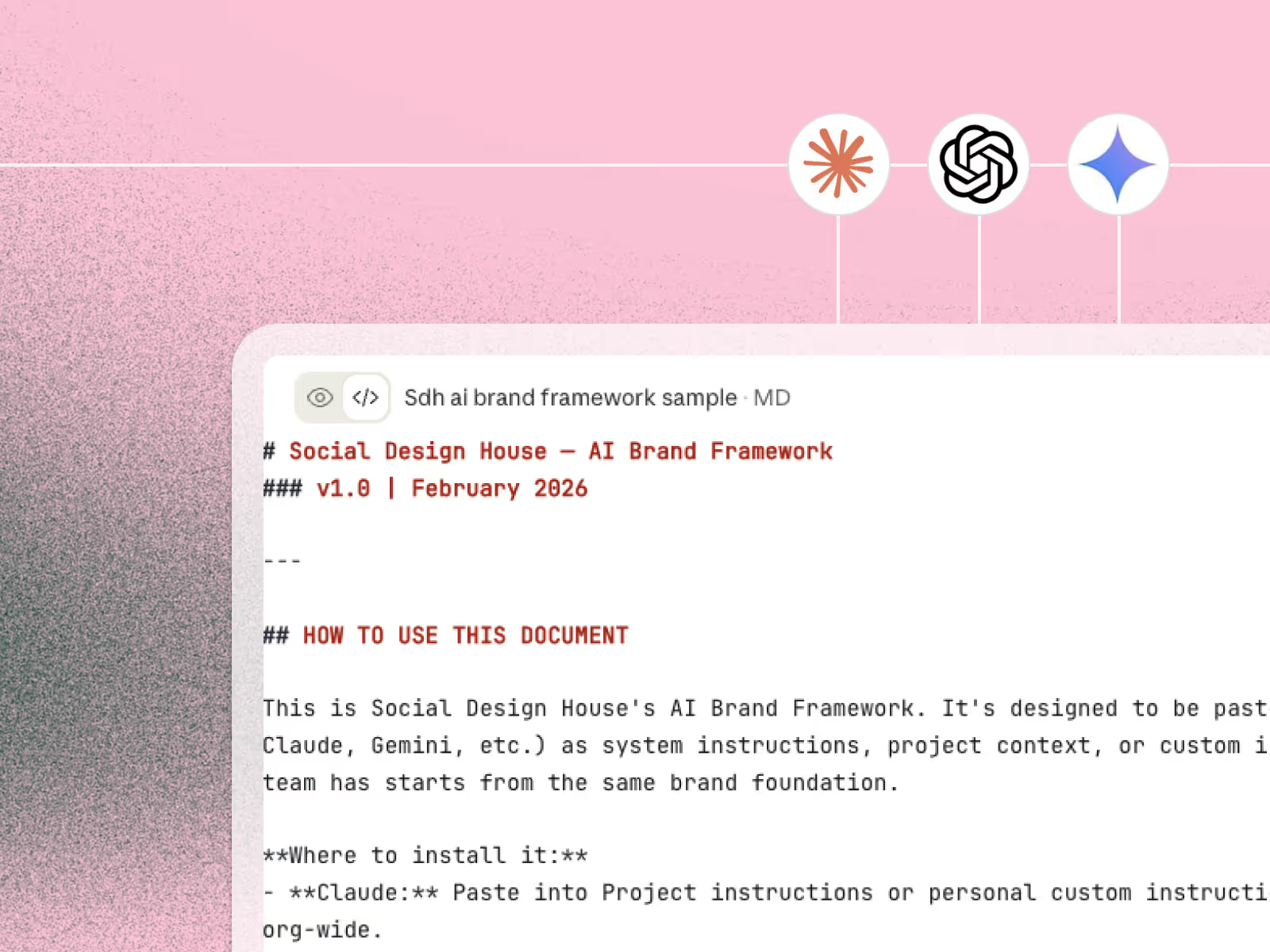
At Social Design House, we built the AI Brand Framework. It's our answer to the alignment problem, and it's now a core deliverable we package alongside every brand we build. At its core, it's a markdown document. Plain text, structured specifically so large language models can actually read and apply it.
Think of it as your brand style guide's companion piece. Same DNA, different format, built for a different audience. And it's something we created specifically because we kept seeing the same problem across our clients: teams using AI with zero brand context.
We pack it with the stuff that actually matters when AI is doing the writing:
Company identity. Name, positioning, what you do, who you do it for. The basics, but structured so AI can reference them in every conversation.
Ideal customer profiles. Because AI needs to know who you're talking to, not just what you're saying. A SaaS founder and a museum director need very different language, even from the same brand.
Voice and tone. And not just the aspirational stuff. We include what you don't say. The words you avoid. The phrases that make you cringe when you see them in a draft. I keep a running list of banned words and phrases for our own studio, and it shapes the output more than you'd think.
Core services and differentiators. So the AI understands what you actually offer and how you stand apart from the next company in your space.
Values. The ones that drive real decisions, not the ones on a poster nobody reads.
Writing style references. We can tell the AI to write like a specific person or in a specific style. If your founder has a casual, direct tone, we build that in. If your brand leans more polished and structured, we calibrate for that. The goal is that AI output sounds like your team wrote it.
Visual context. Primary and secondary typefaces, your website URL, social handles. Even schema references for the more technical setups. You'd be surprised how much grounding AI gets from knowing where your brand lives online.
If you've ever managed a brand, you already understand the concept instinctively. You wouldn't let someone stretch your logo or swap your brand colors for something they liked better. Don't squish it, don't stretch it. There are rules. Standards. Guardrails. We've had those for visual identity for decades.
AI output needs the same thing.
Without a shared foundation, you're managing a dozen different versions of your brand voice across every tool and every team member. And nobody's checking it. Marketing sounds one way, sales sounds another, and your CEO's LinkedIn posts sound like a third company entirely. That's not a productivity win. That's a consistency problem.
Our AI Brand Framework is a .md (markdown) file. Lightweight, portable, and it works across every major AI platform. One file, multiple destinations. Here's a quick look at how it plugs in:
Claude (Anthropic)
If your team is on Claude, the framework drops right into your Project instructions or individual custom instructions. For Claude for Teams, an admin can set org-wide style and context so everyone on the team starts from the same baseline. Every conversation already knows who you are, how you talk, and what you care about. That's huge.
ChatGPT (OpenAI)
For teams on ChatGPT, the framework can be installed into a shared custom GPT. Build one GPT with your AI Brand Framework as its instructions, share it with the team, and now everyone has access to the same brand-aligned starting point. Individual users can also paste key sections into their Personalization settings under "Custom Instructions."
Gemini (Google)
Gemini Gems work similarly. Create a Gem with your AI Brand Framework loaded as context, and your team can access it as a preset. For individual use, the framework content can be added directly into conversation prompts or saved as a reusable template.
The point is the same across all three: one source of truth, distributed to the team, applied consistently. And when the framework gets updated (new messaging, new services, a rebrand), you update one file and redistribute. No chasing down 15 individual setups.
I want to be clear. Our AI Brand Framework doesn't replace your brand style guide. Your designers still need that PDF. Your print vendors still need those specs. We still build those, and they still matter.
The AI Brand Framework sits alongside it. It's the companion deliverable for the way your team actually works now. You hand a new hire the PDF for visual standards and the AI Brand Framework for every AI tool they'll touch in their first week. Because they will touch them. Probably on day one.
Think of it like the foundation we build for our website clients. We try to set a solid foundation that you can build on no matter what changes. Same principle here. The tools will keep shifting, new platforms will pop up, features will change. But the framework stays consistent because it's built on who you are, not which tool you're using.
We build brands at Social Design House. Identity, web, the whole thing. And when we hand off a brand, we want it to hold up. Not just on a business card or a homepage, but in the 47 ChatGPT conversations your marketing coordinator has next Tuesday.
Context is everything. We wrote about this recently, about how AI without context produces generic output and how the brands that invest in giving AI the right information are the ones getting better results. (Link to previous article) Our AI Brand Framework is the practical application of that idea, and it's something we deliver to every client who builds a brand with us.
We've been in this industry for over 16 years, and what I keep coming back to is that the best work happens when there's a clear foundation. Simple, not easy. Building that foundation takes real work, stakeholder interviews, brand strategy, distilling all of that into something structured and usable. But once it's in place, everything that comes after it is better. The AI output is better. The team alignment is better. The brand holds together across every channel.
We're not waiting for the industry to catch up. We built this, we're packaging it as a standard deliverable, and we're handing it to our clients right alongside their brand guides. Because if your team is going to use AI, and they are, it should at least sound like you.
Social Design House is a Charlotte-based creative studio specializing in brand identity and web design. We've been building brands and websites for 16 years and we think a lot about how brands show up, everywhere. Want to learn more about our AI Brand Framework? Get in touch.