No developer, no designer, no problem. Anyone with access to AI can build software but what happens when you get stuck? What happens when your in that vibe loop of death burning tokens and time?

.svg)


"We've got an app one of our team members built in Lovable and it works great, but the credits are getting expensive because our prompts aren't really dialed in. Can someone take a look?"
"Marketing vibe coded an internal tool that's actually really useful, but now other teams want access and we have no idea how to host it or who can see what."
"We vibe coded a customer-facing site on a tight deadline and shipped it, but nobody on our side knows if it's actually secure. How worried should we be?"
If any of these sound like a conversation you've had recently, you're exactly who we're here to help.
The challenge: You built something real but have no idea how to make it accessible to your customers or team. Where does it actually live?
Hosting, servers, DNS records, and deployment pipelines aren't simple — and the wrong setup costs you money, time, and headaches down the road. Our senior engineers have launched hundreds of apps and websites across Netlify, Vercel, AWS, and a myriad of other hosting platforms. We assess what you've built, recommend the right infrastructure, and get it off your machine and into the world.
The challenge: The AI wrote the code. Nobody checked if it was safe.
Researchers analyzed 5,600 deployed vibe-coded apps and found over 2,000 vulnerabilities, 400 exposed secrets, and 175 instances of personally identifiable information sitting in plain sight. Our developers review what's been built before it goes live, flag the holes, write the fix prompts, and verify the patches actually closed the vulnerability. If you're handling customer data, this isn't optional.
The challenge: Your database works, but probably not the way you think.
Row-level security, access controls, backup strategy — these don't come standard in a vibe-coded build. Without them, your users can see each other's data, and any visitor can potentially delete records. We go through the database structure, close the gaps, and make sure the right people can only see the right things.
The challenge: The basics aren't basic when you haven't done them before.
Custom domain setup, SSL certificates, and email deliverability trip up even the smartest people. SPF and DKIM records have to be right or your transactional emails — password resets, receipts, notifications — go straight to spam. We've done this enough times that it's fast for us and saves you credits and time.
The challenge: Your API keys might be sitting in plain sight.
Over half of vibe-coded apps ship with credentials exposed in client-side code. Any person with browser dev tools can grab them. We make sure your keys are stored correctly, rotated properly, and nowhere near the front end.
The challenge: It works, but it looks like every other AI-generated site on the internet.
Without a real brand to work from, the AI guesses — and what it guesses is usually a blue gradient and a hero section you've seen four thousand times. Sandi and the design team build a full design system: logo, color, type, voice, and components packaged into a brand DNA file your AI coding tool can read as context. The output looks like you. Our AI Brand Framework is the formal version of this, and it's the fastest way to close the gap between "AI-generated" and "actually on-brand."
The challenge: You launched. Now you have no idea what's happening.
GA4, Google Search Console, Meta Pixel, CRM connections, webhooks — this is the plumbing that tells you where your traffic comes from, what your users are doing, and whether any of it is working. We set it up at launch so you have real numbers from day one instead of retroactively trying to piece together what happened in October.
The challenge: Your credit bill is climbing and you're not sure you're building the right way.
Loose prompts mean the model rebuilds the same component four times before it figures out what you wanted. Our developers work with you on the structural prompts: what does this feature actually need to do, what does "done" look like, what's the right shape for the database. Tighter prompts mean faster builds, less waste, and a monthly bill that makes sense.
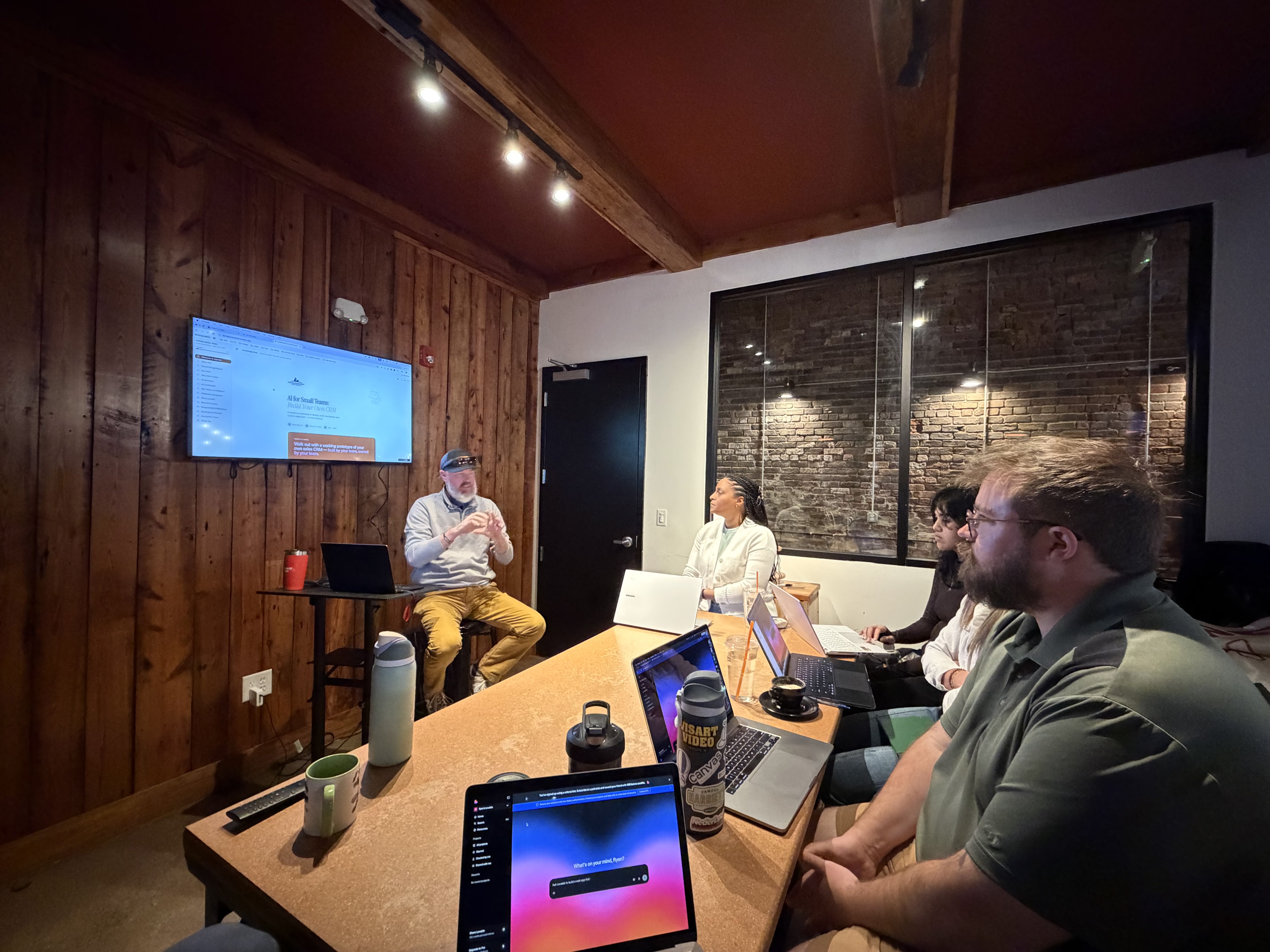
Team enablement. Most of the people building these apps are smart operators who've never had a reason to learn this stuff. So we teach them. We run working sessions, walk your team through what's actually possible, and show them how to prompt, structure, and ship without guessing. The goal isn't to make you dependent on us — it's to make your builders better at what they're already doing.
Prompt engineering. A senior-led development team works on prompts that get to the point and bypass the learning curve. What does this feature actually need to do? What does "done" look like? What's the right shape of the database? Tighter prompts mean less rebuilding, less back-and-forth, and a lower monthly bill.
Launch infrastructure. Hosting, domain, SSL, backups, environment variables, API key rotation. The stuff that's never glamorous and never optional. We've done it enough times that we move fast without skipping anything.
Security review. Before anything goes live, we go through what's been built. We flag the holes, write the fix prompts, and verify the patches actually closed the vulnerability — instead of just looking like they did. If you're handling customer data, this step matters a lot.
Post-launch setup. GA4, Search Console, CRM integrations, webhooks. All the stuff people forget about for two months and then panic about. We get it set up at launch so you know what your app is doing from the moment it goes live.
South Mint is a Charlotte performance media firm. We vibe coded their site with a combination of Claude Design and Claude Code. Hosting is a simple Netlify instance. Brand identity and design system came first — we packaged the brand DNA into a context file, art directed the build, and shipped on a tight deadline. The team manages it themselves now, iterating as they go. The brand holds up because the foundation was solid.
Nexus Point is a different set of challenges. They've enabled an internal employee who comes from operations. She's sharp, she can prompt, she ships. What she doesn't have is fifteen years of pattern recognition for what's going to break in six months — and she doesn't need it, because that's what we're there for. Retainer setup. Dedicated Slack channel. Biweekly check-ins. We review prompts before they go in, help break complex features into sprints, and work through the messy stuff when it comes up. She keeps building. We keep it from going sideways.
If you have a senior dev team in-house, you probably don't need us. If you want a traditional agency to build the whole thing, that's also something we do — but it's not this.
Project-based — Defined scope, fixed price. Good for a launch sprint, a brand foundation for an existing vibe-coded build, or a security review on something you've already shipped.
Retainer — Dedicated Slack channel, biweekly check-ins, ongoing access to the full team. Good for builders who are actively shipping and want experienced eyes on a regular basis.
Both options include the whole crew: two developers, three designers, strategy, and account.
What is vibe coding support?
Senior-led design, development, and launch help for teams building apps, websites, or internal tools with AI coding platforms like Claude Code, Cursor, Lovable, Replit, Bolt, or Base44.
What tools do you support?
All of the above, plus most platforms in the space. We work inside whatever you're already using.
Can you help with hosting and launch only?
Yes. If you've already built the app and just need to get it live, secure, and tracked, we offer launch-only engagements.
Do you review existing apps for security issues?
Yes. Our developers go through what's been built, flag vulnerabilities, write the fix prompts, and verify the patches.
How does the brand foundation work?
We build a design system, brand DNA file, and design.md that loads into your AI coding tool as context. The model uses it as the source of truth — on-brand output, fewer credit-burning guesses.
Where are you based?
Charlotte, NC. We work with clients across the Carolinas and remotely across the US.