Learn how to optimize website for conversions and multiply pipeline value with proven CRO frameworks, funnel diagnostics, and testing strategies.



To optimize your website for conversions, choose one valuable action to measure, such as a qualified form submission or purchase. Find where visitors drop off, remove the biggest barrier, then test the change. Start with pages that get meaningful traffic. Make the offer clear, keep calls to action easy to find, shorten forms, and check the experience on mobile.
This approach helps more visitors take the next step and can increase pipeline value without requiring more traffic. I’m Ben Visser, founder of Social Design House, where our goal is to help brands optimize website for conversions through clear messaging and thoughtful design. For 16 years, I’ve led brand and website work for growing organizations, and I’ll walk you through a practical way to find and fix the gaps in your funnel.
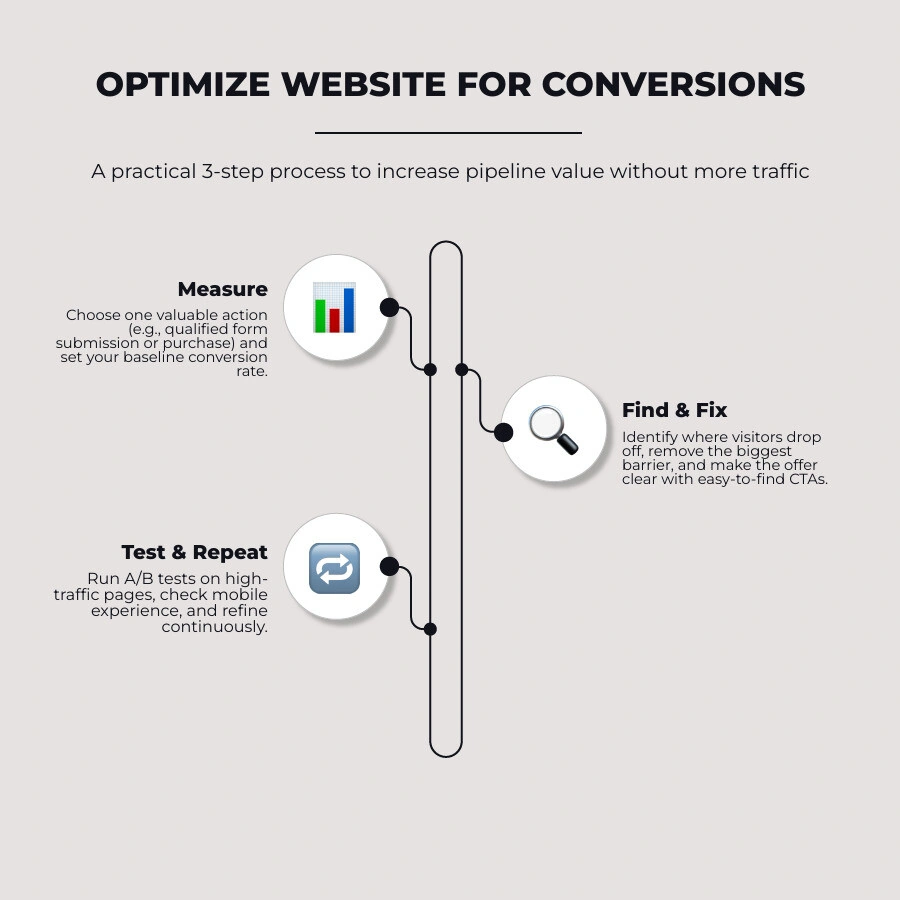
Key terms for optimize website for conversions:
Conversion rate optimization (CRO) turns passive page views into measurable business value. In 2026, relying solely on expanding ad spend or chasing organic search impressions is an expensive uphill battle. When you optimize the journey between a visitor landing on your page and completing a form, you multiply the revenue efficiency of every marketing dollar you invest.
Focusing on pipeline efficiency directly lowers your customer acquisition cost (CAC) and cost per lead (CPL). Imagine your site receives 20,000 monthly visitors and converts at 2%, producing 400 qualified leads at a CPL of $10. By systematically improving your user experience and lifting that conversion rate to 3%, you generate 600 leads from the exact same audience. Your CPL drops to $6.67, creating predictable pipeline growth without inflating your media budget.
Understanding how user actions map to bottom-line metrics requires examining analytics for user experience. When you treat your site as an interactive sales path rather than a static brochure, every layout update, headline revision, and form field directly influences customer lifetime value. Structured frameworks like The C.O.N.V.E.R.T. Method framework for engineering websites that sell demonstrate that conversion optimization succeeds as a linked system, connecting message clarity, trust signals, and smooth usability into a repeatable growth engine.
Before testing new layouts, you need an accurate picture of your current baseline. The standard conversion calculation is simple: divide the total number of conversions by the total number of unique visitors (or sessions), then multiply by 100 to get your percentage.
For example, if your landing page records 250 contact form submissions from 5,000 unique sessions over a 30-day window, your baseline conversion rate is 5%.
In Google Analytics 4 (GA4), track both macro and micro conversions to view the full picture:
Across global benchmarks, the average conversion rate across all industries ranges between 2.35% and 5.31%, though broad industry-wide averages settle near 1.7% to 2.74%. When tracking these metrics, align your numbers with clear internal goals for measuring business success, keeping your team focused on pipeline revenue rather than arbitrary numbers.
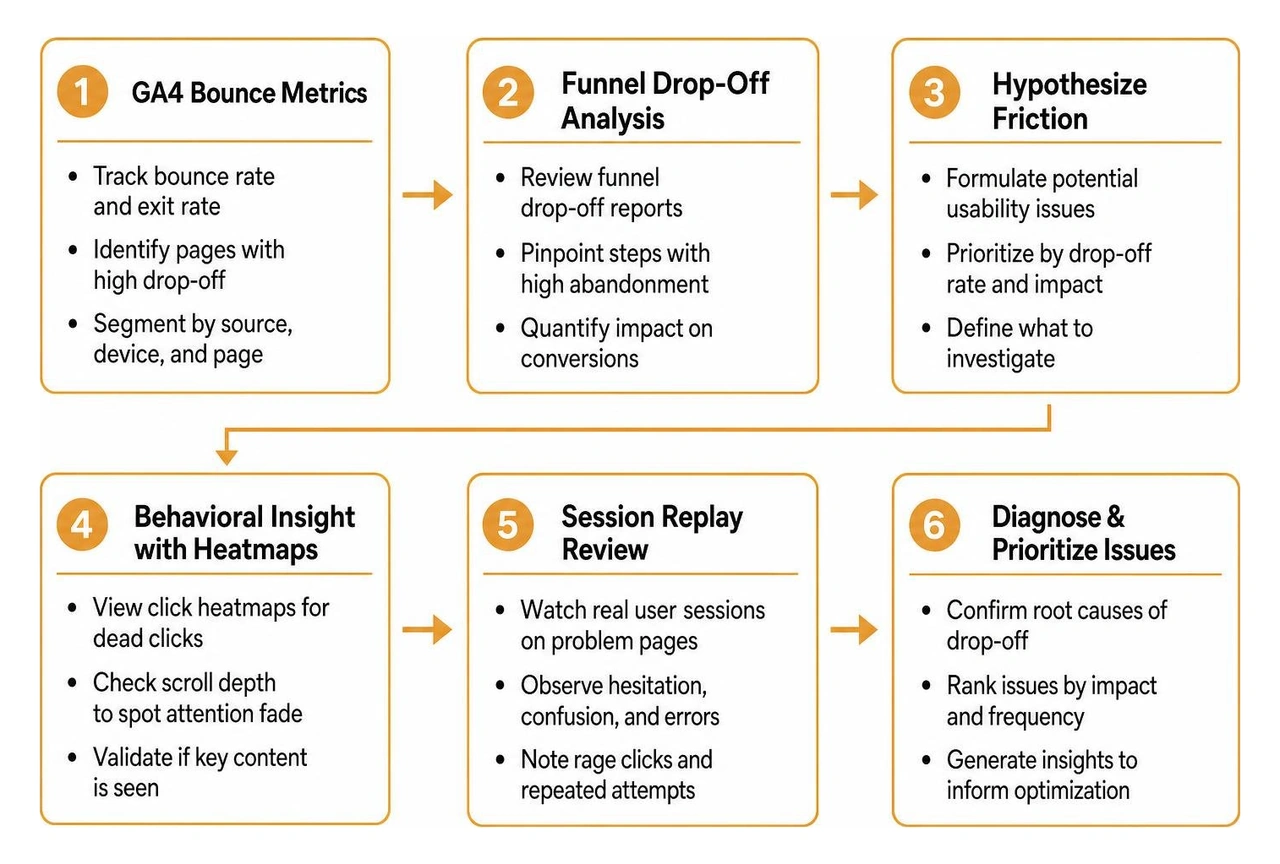
Finding where users abandon your site requires combining hard quantitative data with visual, behavioral insights. When teams see numbers drop, they often realize their website is not converting because unseen usability obstacles block the path forward.
Deploy heatmaps, scroll maps, and session recordings to uncover these common friction points:
Systematic conversion optimization relies on reducing cognitive friction while answering user intent immediately. When a visitor lands on your page, you have roughly five seconds to pass the clarity test. If a prospect cannot tell who you are, what specific problem you solve, and what step to take next, they will bounce back to the search results.
Clear visual hierarchy and above-the-fold clarity anchor every high-performing layout. Place your primary headline, core benefit statement, supporting trust badge, and prominent call to action directly in the hero section. Minimizing mental fatigue allows visitors to consume your value proposition effortlessly.
| Metric / Priority | B2B Lead Generation | SaaS Platforms | E-Commerce Brands |
|---|---|---|---|
| Primary Conversion Goal | Consultation / Quote Request | Free Trial / Live Demo | Completed Checkout |
| Hero Section Priority | Direct value proposition and authority proof | Interactive product preview and clear CTA | Featured product hero with customer review score |
| Friction Reducer | 2-step short form with work email validation | Instant sign-up without credit card | One-click guest checkout with transparent shipping |
| Key Decision Proof | Client logos, case studies, industry badges | G2 badges, customer ratings, security certifications | Star ratings, unboxing video, money-back badge |
| Primary Drop-off Cause | Lengthy forms asking for budget upfront | Unclear feature sets or confusing pricing | Surprise shipping costs and slow page speeds |
Studying Website Optimization Methods that Meet Your Goals shows that aligning page content directly with visitor expectations produces substantial gains. Review our detailed guide on website conversion design for structured techniques on laying out high-impact wireframes.

Visual design and technical performance operate hand in hand. A visually striking layout fails if pages load slowly on mobile devices. Data shows that a B2B page loading in 1 second achieves a 3x higher conversion rate than one loading in 5 seconds. Additionally, roughly 53% of mobile shoppers abandon pages that take longer than two seconds to load.
To engineer frictionless experiences:
Review our breakdown of website design for conversion alongside industry research on optimizing web performance and UX for conversions to keep your user experience fast, accessible, and focused.
Your calls to action (CTAs) and capture forms represent the exact point where traffic turns into revenue. Generic button labels like "Submit" or "Click Here" create hesitation. Instead, write specific, action-oriented button copy that reinforces the immediate benefit, such as "Get My Free Audit," "Book Your 15-Minute Demo," or "Start Your Free Trial."
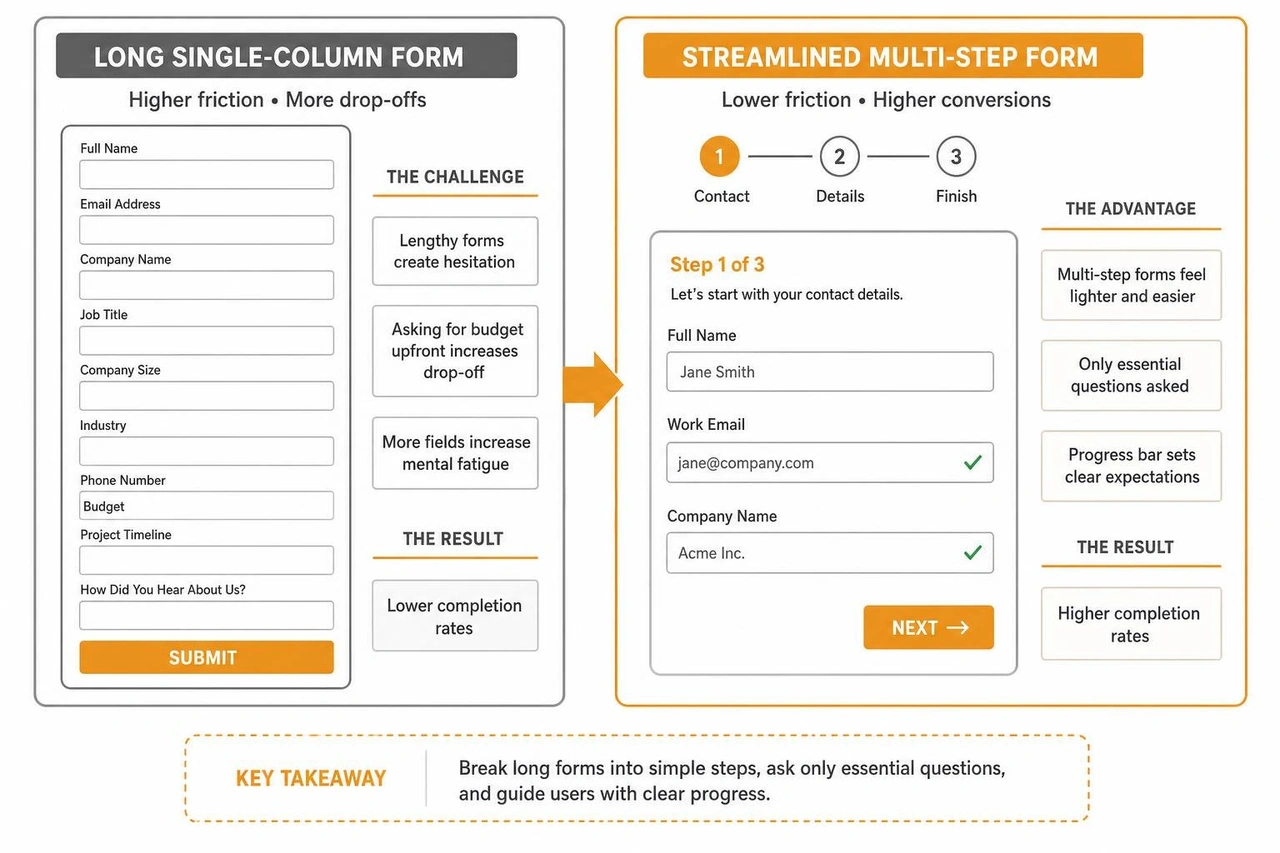
When designing forms, eliminate every unnecessary field. Research shows that cutting form fields down to essential questions increases submissions significantly. For longer inquiries, use multi-step forms with progress bars. Breaking six questions across three quick screens feels far lighter than presenting a daunting wall of inputs. Add inline validation so users receive immediate green checkmarks as they complete fields, and enable browser autocomplete for contact information.
Applying these refinements makes generating qualified leads online an intuitive, frictionless experience for every prospect.
High-converting websites align with natural human decision-making. When visitors evaluate your service, they weigh perceived value against risk, effort, and uncertainty. By embedding proven psychological principles, you guide prospects toward confident purchasing decisions.
Key behavioral triggers include:
Understanding these mental models is essential when building an effective SaaS website, where simplifying complex technical offerings directly accelerates sales cycles.

Trust is the single most valuable currency on your website. Over 70% of shoppers abandon purchases or checkout funnels when a site feels untrustworthy. Conversely, visitors who interact with verified customer reviews are 58% more likely to convert into paying clients.
Integrate verified proof points directly beside high-friction decision areas:
Weaving these trust assets into your site structure reinforces your authority when attracting clients online.
Creating genuine urgency encourages prospective buyers to act now rather than postponing their decision indefinitely. Adding real-time elements like a countdown timer for a scheduled promotion or workshop can lift revenue by up to 9%.
Proven methods for introducing genuine urgency and risk reversal include:
These tactics encourage decisive action when converting high-value consumers online.
Search engine optimization and conversion rate optimization share the same objective: satisfying user search intent. Bringing thousands of organic visitors to your site creates zero pipeline value if visitors leave without taking action. At the same time, high bounce rates and poor Core Web Vitals send negative quality signals that harm your search rankings.
When you align organic landing page content with search intent and embed contextual CTAs, you maximize pipeline velocity. Tracking these outcomes requires measuring organic search success through conversions and revenue, rather than relying solely on keyword rankings.
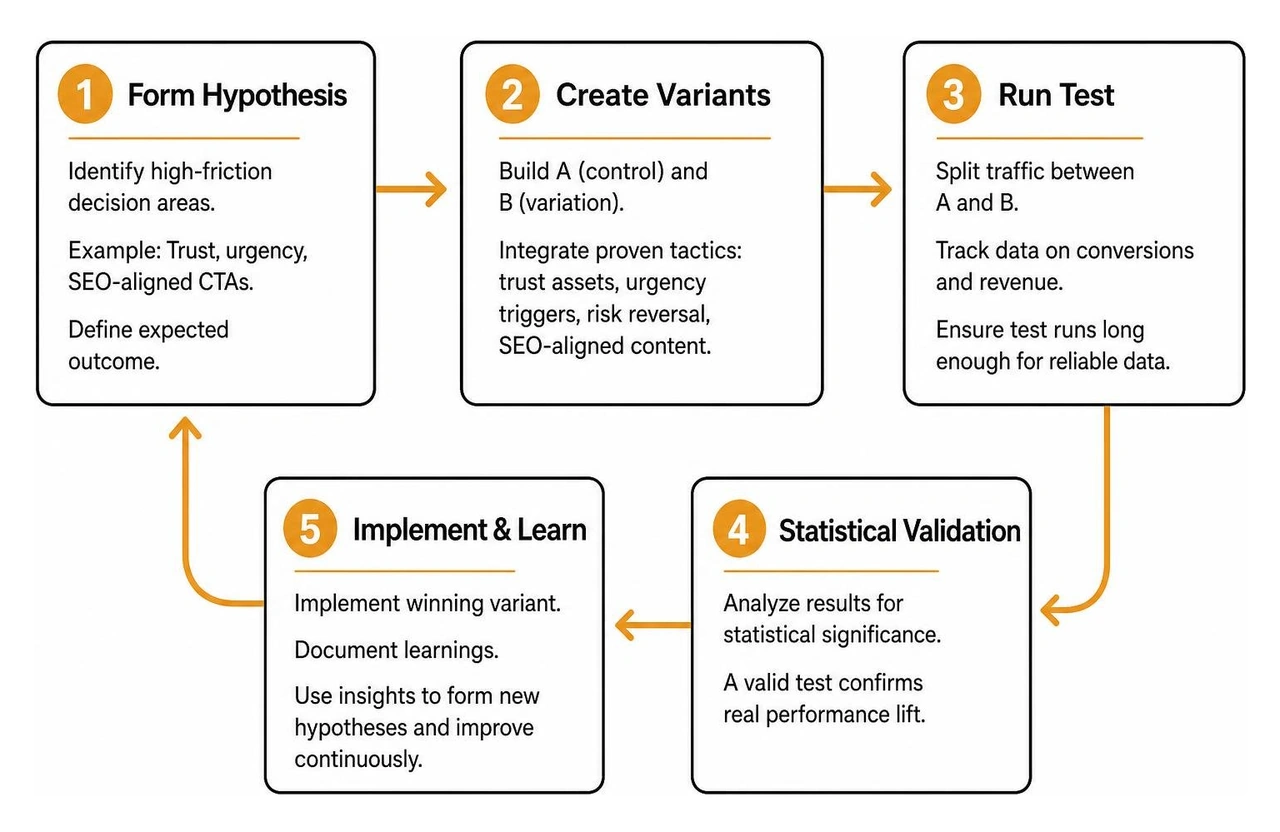
Never change website layouts based on guesswork. A structured testing methodology ensures every update delivers validated improvements.
Follow this five-step experimentation process:
For detailed testing checklists, reference our Website Conversion Testing Guide 2026.
Even seasoned marketing teams encounter pitfalls that compromise their conversion data. Avoid these six common mistakes:
A competitive website conversion rate typically ranges between 2.5% and 5% depending on your industry, business model, and traffic sources. Specialized e-commerce categories like beauty and personal care often see average rates above 5%, while high-ticket B2B services, luxury goods, and real estate naturally average around 1% to 2% due to longer sales cycles. Focus on improving your baseline conversion rate and lead quality over time rather than chasing broad industry averages.
SEO brings qualified organic search traffic to your site by matching user search intent, while CRO ensures those visitors find a fast, intuitive, and persuasive experience once they land. UX signals like fast load speeds, low bounce rates, and long session durations support your organic rankings, while conversion-optimized layouts turn that search visibility into qualified pipeline opportunities.
Begin optimizing your highest-traffic, highest-intent pages to see immediate business results:
Systematically improving your conversion funnel transforms your website into a reliable revenue driver. By establishing an accurate baseline, streamlining user paths, applying behavioral trust principles, and validating design updates through structured testing, you multiply pipeline value from your existing traffic.
At Social Design House, we have spent 16 years operating as a collaborative, 10-person fractional creative studio in Charlotte, NC. We work as an extension of your internal team, helping growth-focused organizations build award-winning brand strategies, high-performing websites, and clear messaging. Through our AI Brand Framework, we help ambitious teams craft purposeful digital experiences that clarify value, remove friction, and deliver sustainable business growth. Find your sweet spot, test with intention, and build a conversion path that turns clicks into long-term clients.