Find the best commercial real estate websites for sourcing deals, comparing top platforms like LoopNet and VTS to uncover off-market properties in 2026.
.svg)


Evaluating the landscape of commercial property marketplaces involves looking at audience reach, data depth, and platform specialization. Modern platforms serve distinct needs, ranging from high-traffic public marketplaces to automated marketing engines and auction networks.
| Platform Category | Leading Platforms | Primary Focus & Capabilities | Key Performance Insights |
|---|---|---|---|
| National Marketplaces | LoopNet | Mass buyer/tenant exposure, national search filters | Over 1.3 billion visits annually |
| Auction Platforms | Ten-X | Accelerated transparent sales, upfront bidder qualification | 13M monthly visitors, 95% close rate, 97-day list-to-close average |
| Flat-Rate Directories | TotalCommercial | Budget-friendly nationwide listing management | Flat rate annual listing models |
| Leasing & AI Operations | VTS | Lease abstraction, real-time demand tracking, asset workflows | Built on 57B+ SF of deal data and 300M+ real-time signals |
| Marketing & Document Platforms | CREBuilder | Automated OM creation, deal rooms, automated graphics | 155M+ property records, saves $300+ per document |
National marketplaces provide maximum listing exposure for asset sellers while giving buyers broad access to office, industrial, retail, and multifamily listings.
LoopNet continues to stand out as the highest-traffic commercial real estate marketplace, generating over 1.3 billion visits annually. It operates as a primary destination for investors searching for on-market deals across major and secondary metropolitan areas.
For property owners who want a fast, direct path to closing, integrated transaction engines offer speed and buyer transparency. Ten-X | TenX integrates directly with major listing platforms to bring structured bidding online. The platform attracts 13 million unique monthly visitors and achieves a 95% close rate by requiring upfront bidder qualification and document review prior to the auction. This approach condenses the traditional sales timeline down to an average of 97 days from initial listing to close.
For brokers looking for simple, fixed-cost listing distribution without transaction fees, flat-rate marketplaces like TotalCommercial provide nationwide reach with unlimited property postings.
Beyond traditional search portals, platforms built on real-time deal data and artificial intelligence are transforming property operations and deal preparation.
Platform ecosystems like VTS | Commercial Real Estate Software power asset management and leasing operations using massive data models. Built on over 57 billion square feet of deal data and more than 300M+ real-time data points, VTS uses AI to transform raw lease documents and LOIs into structured financial metrics. Its AI tools speed up proposal creation by up to 93% and reduce document search times significantly, giving asset managers real-time visibility into market demand.
For property marketing and deal packaging, platforms like CREBuilder - CRE Marketing Packages in Minutes connect to property databases containing over 155 million records. These tools allow brokers to auto-populate property data, tax details, and demographic maps into offering memorandums, sales teasers, and NDA-gated digital deal rooms in minutes, saving brokers over $300 per document compared to traditional graphic design production.
Navigating the commercial property market requires understanding how listing visibility affects price competition, deal velocity, and seller terms.
On-market listings are publicly advertised on major property sites. They offer clear pricing baselines, detailed historical performance records, and standardized offer processes. Because these listings are open to all market participants, competitive bidding can push pricing higher and reduce cap rates.
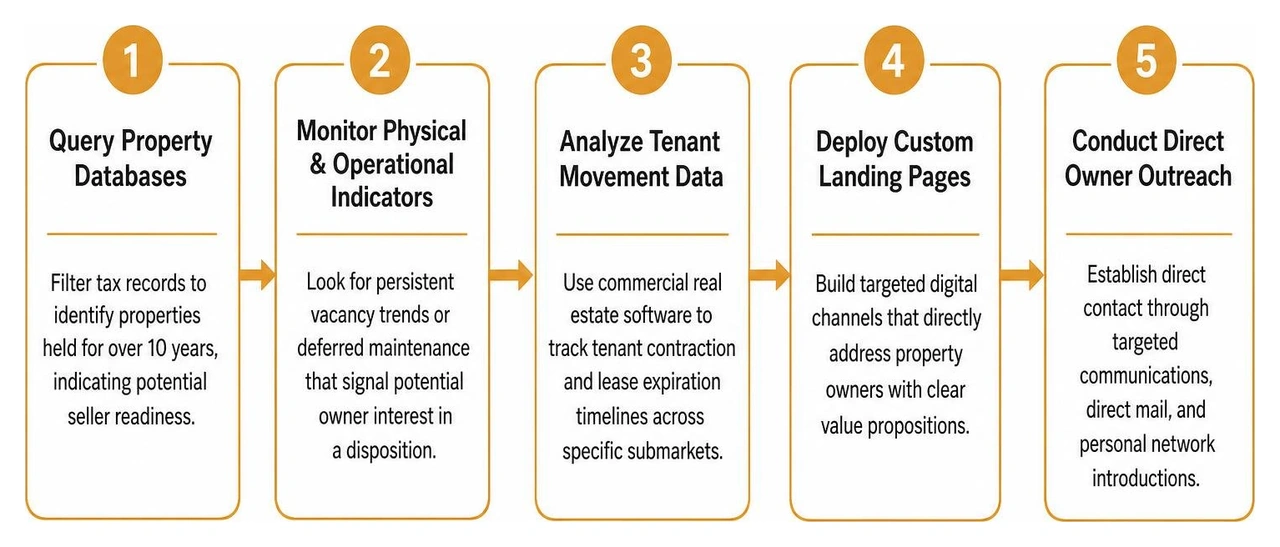
Off-market opportunities are properties not listed publicly on standard search platforms. Sellers may prefer off-market transactions to preserve tenant privacy, avoid public repricing signals, or skip lengthy open-market marketing campaigns. Identifying off-market deals requires active owner research, custom database querying, and localized relationship building.
For developers and sponsors, matching the right deal sourcing method to the project scope is critical, as detailed in our comprehensive Commercial Real Estate Developer Guide 2026.
Whether searching on national portals or evaluating single-property destination sites, successful deal discovery relies on effective digital platform features.
Sourcing off-market real estate requires a systematic strategy to identify property owners who may be receptive to direct offers.
While national platforms offer broad audience reach, regional databases provide hyper-local listing precision backed by regional real estate organizations.
Regional databases rely on direct inputs from local brokers, regional economic development offices, and local appraisers. These databases often maintain strict verification schedules. Regional platforms can ensure high data accuracy, with some requiring brokers to verify property availability every 45 days. Local databases also provide deep market context by combining transaction comparables with regional economic development planning.
National platforms emphasize scale, aggregating millions of records across the country to serve institutional buyers, multi-market tenants, and site selection consultants.
Regional networks connect local real estate listings to nationwide audiences through property syndication.
Local databases maintain deep relationships with area economic development agencies, providing access to historical sale data, zoning records, and infrastructure planning tools. Through syndication channels, properties posted on local networks auto-distribute to broader commercial directories. This process ensures regional listings reach national site selectors while preserving local data accuracy.
Relying exclusively on third-party listing platforms can limit a firm's ability to build independent brand equity and control the client experience.
National brokerages such as Global Commercial Real Estate Services | CBRE and Commercial Real Estate Company | Transwestern use custom digital platforms to highlight proprietary market research, showcase high-profile assignments, and deliver specialized advisory services.
For growing regional brokerages, developers, and investment firms, a dedicated website serves as an anchor for digital marketing efforts. Explore how targeted digital strategies drive growth on our Commercial Real Estate Website Marketing Charlotte page. Custom sites allow firms to showcase portfolio achievements, capture high-intent buyer leads, and tell their brand story without competing for attention alongside rival listings on third-party portals.
Pricing structures vary based on platform scope and feature access:
Regional databases prioritize localized data accuracy and broker-driven property verifications. They offer deep market context within specific geographic markets. National platforms focus on volume and cross-market accessibility, reaching a broader national audience of investors and corporate tenants.
Artificial intelligence and automation are changing CRE operations by streamlining data abstraction and deal preparation:

Third-party commercial real estate listing sites are essential for broad property exposure, but building a memorable brand requires a custom digital destination that you own and control.
Social Design House is a Charlotte-based 10-person creative studio with 16 years of experience operating as a fractional creative team. We partner with commercial real estate developers, brokerages, and investment firms to build digital experiences that turn property portfolios into clear competitive advantages.
Our core services include brand identity and strategy, web design and development (Webflow and WordPress), content creation and copywriting, performance marketing, and our proprietary AI Brand Framework. We built our AI Brand Framework to help growth-focused commercial real estate brands clarify their market positioning, streamline content workflows, and capture high-value buyer interest.
Whether launching a multi-building development or expanding a regional brokerage footprint, we bring creative focus to every touchpoint. We live by simple mantras that keep projects on track: Be the meeting you want to go to, Simple, not easy, Clarity is a gift, and We're an extension of your team.
We help commercial real estate teams create real impact online, live their brand values, and Find your sweet spot..
Visit our Charlotte Branding and Website Design Agency page to explore our work and learn how we can help strengthen your commercial real estate web presence. We are excited to collaborate on your next property showcase.